
Power Without Tension: The Biomechanics of an Effective Tennis Forehand
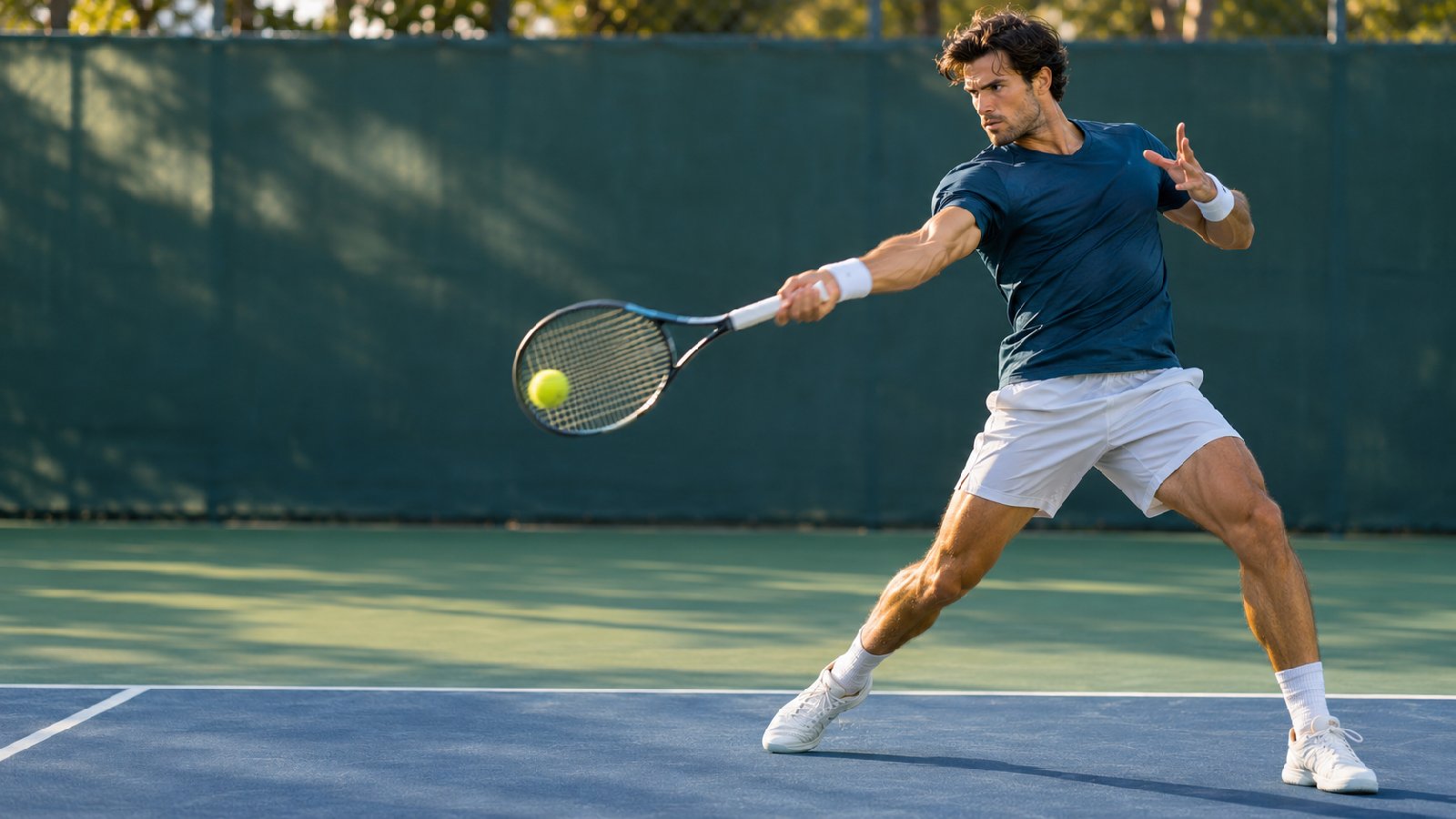
A research-informed analysis of efficient acceleration, muscular coordination and modern tennis forehand technique.
MoveToCompete | Tennis Science
Summary
Why can some tennis players hit the ball at impressive speed without appearing tense, while others make a great physical effort yet generate relatively little racket-head speed?
The answer lies in the biomechanics of the stroke, coordination between body segments and the nervous system's ability to produce acceleration at the right moment.
Research indicates that a powerful forehand does not come from an isolated wrist action or maximum arm tension. It emerges from coordinated contributions of the lower limbs, pelvis, trunk, shoulder and racket.
At the same time, simply relaxing as much as possible is not the solution. An effective stroke balances freedom of movement with stability at ball contact.
This article reviews the evidence, addresses common technical misconceptions and offers practical ways to develop a faster, more stable and economical forehand.
1. The biomechanics of a powerful forehand
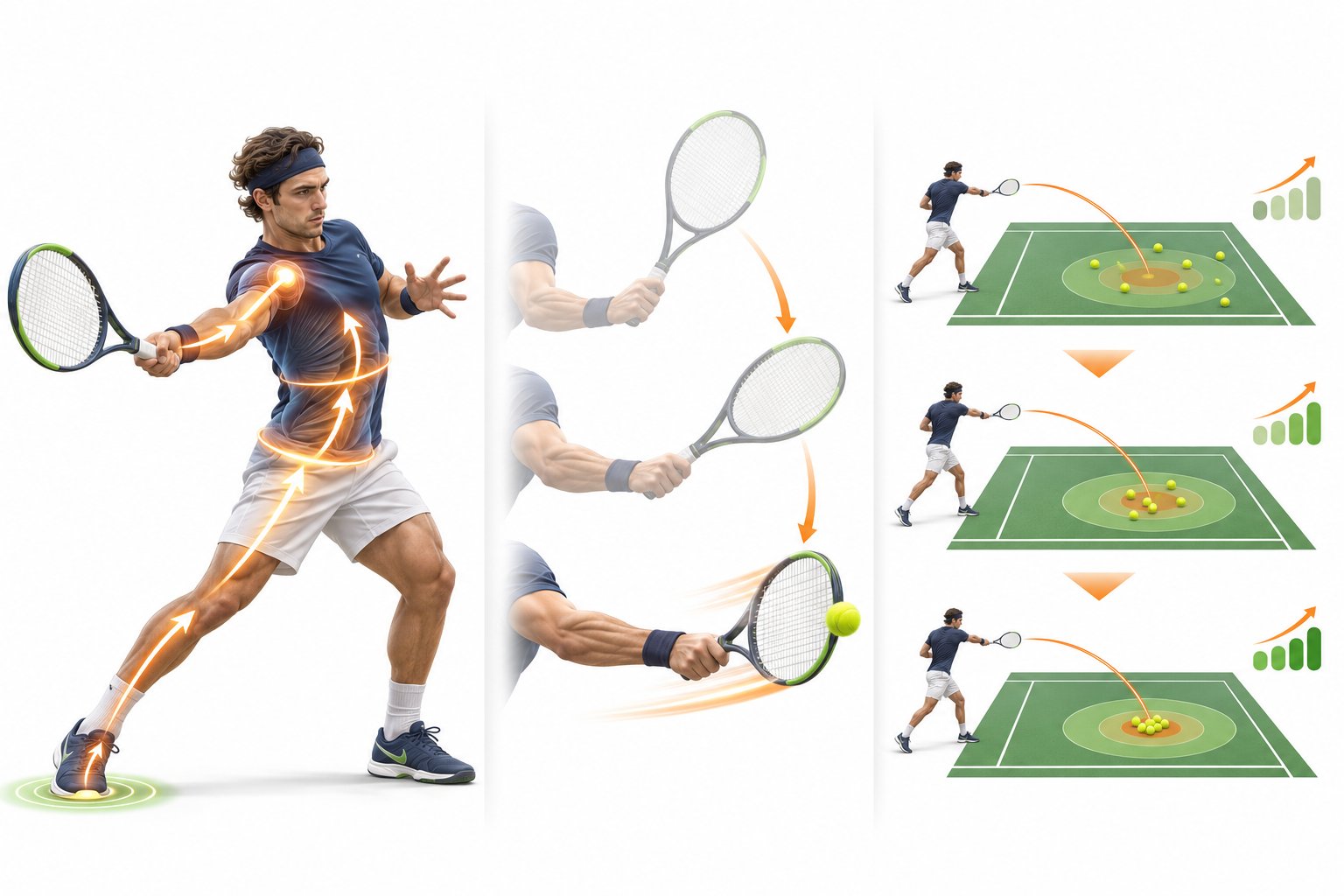
1.1. The kinetic chain: the basis of acceleration
In sports biomechanics, the kinetic chain describes how different body segments interact during a complex movement.
In a tennis forehand, this includes:
- Creating support and force through the legs.
- Movement and rotation of the pelvis.
- Rotation of the trunk.
- Movement and rotation of the upper arm.
- Coordinated movement of the forearm, wrist and racket.
These actions do not occur as five completely separate steps. They overlap in time and form a coordinated system.
In their review, Mechanics and Learning Practices Associated with the Tennis Forehand, Reid, Elliott and Crespo (2013) identify pelvic and trunk rotation, shoulder horizontal movement and internal rotation of the upper arm as key mechanisms for generating racket speed.
Studies discussed in the review suggest that, under particular experimental conditions:
- Shoulder horizontal movement contributes about 25% of racket speed at impact.
- Internal rotation of the upper arm may contribute about 35%.
- Forearm pronation and elbow extension make a comparatively small direct contribution to speed.
These are not universal percentages for every player and every stroke. They depend on technique, grip, the incoming ball and measurement conditions.
Practical takeaway: Trying to accelerate the racket mainly with the wrist overlooks more important mechanisms that create forehand speed.
1.2. Why coordination matters more than maximal force
In strength training, the goal is often maximal muscular effort. The task in a tennis forehand is different.
The player must generate high racket speed while controlling racket orientation, shot direction, contact and ball spin.
Excessive simultaneous activation of the muscles producing a movement and their antagonists can increase resistance to that movement.
That does not mean all muscle coactivation is harmful. Some is necessary to stabilise joints and control the racket.
A more accurate description of an effective forehand is:
Sufficient muscular activity, in the right sequence and at the right time.
2. The wrist: free movement or an active snap?
One of the most common pieces of tennis advice is: “Relax your wrist.”
The instruction can help, but it is often misunderstood.
2.1. What is racket lag?
As the racket accelerates, its head can trail behind the movement of the hand. This is known as racket lag.
It results from the interaction of:
- The racket's inertia.
- Hand acceleration.
- Wrist position.
- Forces and torques produced by the muscles.
- Coordination across the shoulder, elbow and forearm.
Racket lag should not be treated as a goal in itself. It is part of the overall organisation of the stroke.
Deliberately holding the racket back or creating the largest possible wrist angle may disrupt natural coordination.
2.2. The myth of snapping the wrist
A professional forehand can look as if the wrist snaps sharply just before contact.
However, Reid and colleagues note that visible forearm and wrist movements may largely follow from earlier movements and torques at the trunk and shoulder.
Seeing the wrist move does not prove that the player consciously uses it as the main source of acceleration.
Active, uncontrolled wrist flexion can change racket-face orientation and make contact less repeatable.
The principle is not “snap the wrist,” but “let the racket accelerate freely while keeping the string bed under control.”
2.3. How tightly should you hold the racket?
Research on grip force shows that it changes during the forehand.
Reid and colleagues discuss earlier measurements in which grip forces increased during roughly the final 50 milliseconds before contact.
This supports the idea that grip pressure is not constant throughout the stroke.
It does not show that every player should consciously squeeze the racket exactly 50 milliseconds before the ball. Such precise voluntary control is probably impractical.
For most recreational players, a more useful cue is:
Hold the racket loosely enough for a smooth acceleration, but firmly enough to control the shot.
3. The role of the legs, pelvis and trunk
A powerful forehand begins well before the racket reaches the ball.
Body position, balance and preparation create the conditions for effective acceleration.
3.1. Loading and rotation
During preparation, the player turns the trunk, organises support and sets the racket.
During acceleration, movement of the lower limbs and body rotation help drive the upper arm and racket.
Research suggests that trunk movement matters not only as a direct contributor to speed, but also through its influence on the shoulder muscles.
This helps explain why a powerful forehand looks like a whole-body action rather than a stroke made only with the arm.
3.2. Open, semi-open or neutral stance?
There is no single stance for every situation.
An open stance allows substantial body rotation and can support quick recovery for the next shot.
A semi-open stance often offers a compromise between rotation, balance and movement toward the ball.
A neutral stance may be useful when moving forward and for some more linear shot trajectories.
The choice depends on distance to the ball, preparation time, intended direction and tactical context.
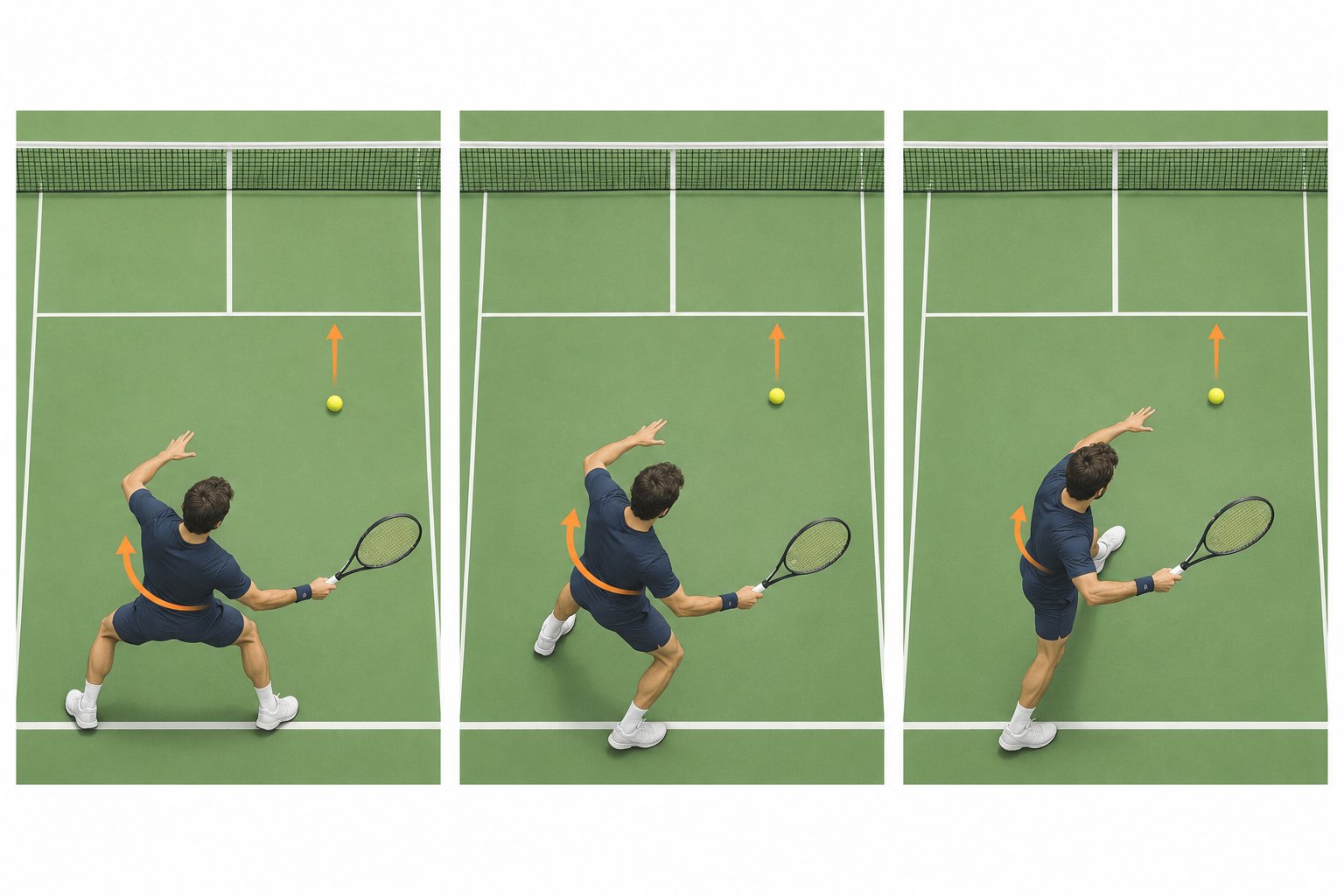
Practical takeaway: Rather than trying to reproduce one stance every time, players should learn to organise an effective stroke from different positions.
4. Why excessive tension can impair the forehand
Tension has both physical and psychological components.
As the ball approaches, some players begin consciously controlling every part of the movement.
They think about the wrist, elbow, shoulder, pelvis, contact and follow-through all at once.
This can make an already-learned complex movement harder to execute.
4.1. Internal versus external focus of attention
An internal focus directs attention to the body, for example:
“Turn your shoulder, relax your wrist and extend your elbow.”
An external focus directs attention to the effect of the movement, for example:
“Accelerate the racket smoothly toward the target.”
A 2024 systematic review by Starzak and colleagues, published in PLOS ONE, examined attentional focus during skill learning and performance in racket sports.
After reviewing the literature, the authors included nine studies in their quantitative analysis.
Overall results support benefits of an external focus, especially for beginners and less-skilled athletes.
This does not mean that technical cues about individual joints are useless. They may be needed to correct a specific error.
But during free play, consciously controlling every movement is not always the most effective strategy.
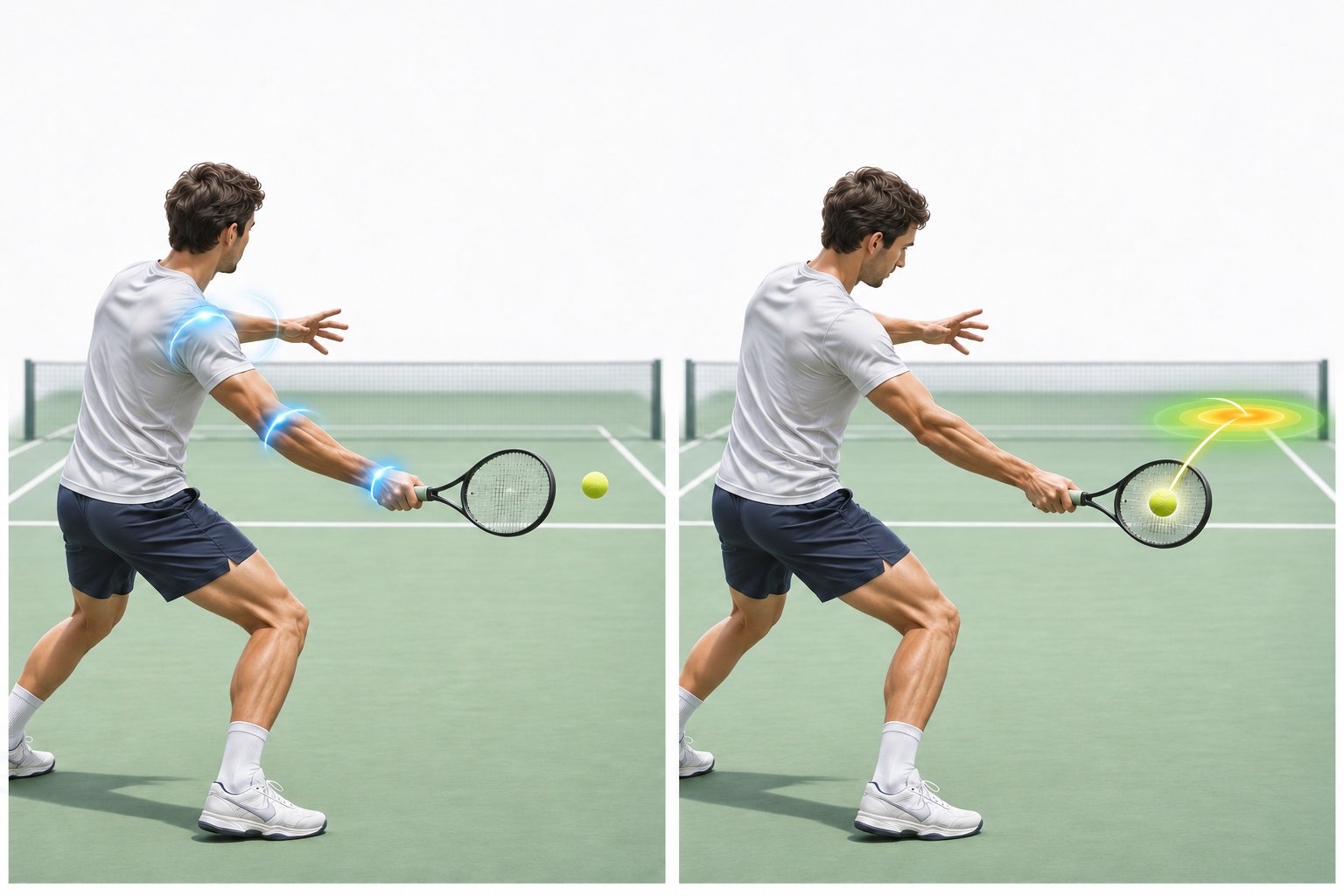
4.2. From technical thinking to an automated movement
Effective learning can include two different modes:
Technical correction: The player consciously works on one element, such as racket position during preparation.
Performance: The player focuses on the ball's trajectory, depth and direction.
Gradually moving from the first mode to the second helps the new technique transfer to real play.
5. How to train free acceleration
The following drills are practical suggestions based on the biomechanical principles reviewed here. They are not a separately validated training programme.
Drill 1: Skipping-stone throw
Goal: Develop a feel for smooth arm acceleration.
The player imitates throwing a flat stone across the surface of water.
The movement should involve the legs, body and arm without excessive tension.
After several repetitions, transfer the movement to a racket swing without a ball.
Note: Throwing is a movement analogy, not an exact biomechanical model of the tennis forehand. Do not copy the wrist action literally.
Drill 2: Free swing with a controlled contact point
Goal: Develop acceleration without losing control.
The player makes smooth swings, gradually increasing speed.
At a chosen point, pause to check approximately where the racket would meet the ball.
This is a positional-awareness drill, not an exact simulation of a real stroke, because stopping changes the natural swing mechanics.
Then progress to slow feeds.
Drill 3: Rotation and balance
Goal: Improve interaction between the lower and upper body.
From a semi-open stance, the player hits controlled forehands.
Focus on stable support, smooth rotation and regaining balance after the shot.
The pelvis does not need to rotate as fast as possible. Whole-body coordination matters more.
Drill 4: Focus on the target
Goal: Transfer technical improvements to a playing situation.
The player selects a large target area in the opposite court.
Instead of thinking about the wrist and elbow, focus on the ball's trajectory and depth.
Gradually increase feed speed and vary the incoming balls.
6. How to measure real progress
The subjective feeling of a freer swing is not enough to prove technical improvement.
Track several indicators:
| Indicator | What it measures |
|---|---|
| Ball speed | Resulting acceleration after contact |
| Shot depth | Trajectory control |
| Successful-shot rate | Consistency and accuracy |
| Ball spin | Shot characteristics, when suitable measurement is available |
| Perceived effort | Subjective physical demand |
| Video analysis | Preparation, contact, balance and sequence |
Racket speed and ball speed are not identical measures. The result is also affected by the incoming ball, contact location, string-bed orientation and the ball-string interaction.
For a practical comparison, use two sets of 20–30 balls under similar conditions.
Hit one set with the usual technique and the other with cues for free acceleration.
Repeat the test across several sessions and account for order effects. Otherwise, differences may reflect warm-up, fatigue or normal variation.
Real progress is not simply a faster swing. It is a better combination of speed, accuracy, control and repeatability.
7. What science has not yet established
Despite the available research, important limitations remain.
First: There is not enough direct evidence that the skipping-stone drill is more effective than other methods for learning the forehand.
Second: There is no universal optimal grip force for every player, racket and playing situation.
Third: A larger racket-head lag does not automatically produce a better shot.
Fourth: A short-term improvement during a lesson does not prove lasting learning. That requires follow-up measurements and tests in real playing conditions.
Fifth: Optimal coordination may differ with individual technique, grip, physical characteristics and tactical demands.
These limitations help prevent useful training ideas from becoming unsupported universal rules.
8. Conclusion: freedom of movement comes from good coordination
A powerful tennis forehand is not created by maximally tensing the arm.
It results from the interaction of muscular force, coordination, technique, well-timed contact and racket control.
Research supports several principles:
- Large body segments play an important role in generating speed.
- Wrist movement should be understood as part of the whole kinetic system.
- Grip force changes across the phases of the stroke.
- Effective learning combines technical drills with outcome-focused tasks.
- Technique should be assessed through speed, accuracy and stability, not only by how easy it feels.
The best forehand is not the one that uses the most effort, but the one that converts available effort into a controlled shot most efficiently.
Scientific references and further reading
[1] Reid, M., Elliott, B., & Crespo, M. (2013). Mechanics and Learning Practices Associated with the Tennis Forehand: A Review. Journal of Sports Science and Medicine, 12(2), 225–231. PubMed record
A review of forehand biomechanics, the kinetic chain, grip, upper-limb movements and coaching practices.
[2] Starzak, M., Niźnikowski, T., Biegajło, M., et al. (2024). Attentional Focus Strategies in Racket Sports: A Systematic Review. PLOS ONE, 19(1), e0285239. DOI
A systematic review of evidence on internal and external attentional focus in racket sports.
[3] Knudson, D., & White, S. (1989). Research on grip forces in the tennis forehand, discussed in the review by Reid and colleagues (2013).
[4] Elliott, B., et al. (1997). Biomechanical studies of upper-limb contributions to racket speed, discussed in Reid and colleagues (2013).
[5] Choppin, S., et al. (2010). Research on the effect of grip force on racket-ball interaction, discussed in Reid and colleagues (2013).
MoveToCompete — knowledge, movement and competitive development.
This material is for educational purposes and does not replace individual assessment by a qualified coach or medical professional when pain or injury is present.